
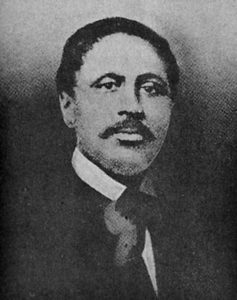
At a time when the law denied his Black citizenship, Macon Bolling Allen fought for — and won — his place in the legal profession. His story is one of self-determination, perseverance, strategy, and hope.
Born August 4th, 1816, and credited as the first Black lawyer to argue before a jury, we celebrate Macon Bolling Allen, for his frontier achievements in securing justice and equity for Black Americans.
Macon was born a free man by the name Allen Macon Bolling in Indiana in 1816. Though much of Allen’s early life is poorly documented, it is proven that he taught himself how to read and write through self-determination and discipline. These skills became the foundation for his professional journey as Allen became a schoolteacher.
In the early 1840s, Bolling moved from Indiana to Portland, Maine where he met abolitionist and lawyer General Samuel Fessenden. Fessenden had recently started a law firm and took on Bolling as his apprentice and law clerk. Having worked with Bolling for 4 years, Fessenden advocated for Bolling’s admittance to the State Bar of Maine. It was around this time that Bolling changed his name to Macon Bolling Allen.
Though free and literate, Allen would still face hardship and discrimination due to his race. According to Maine statutes, anyone of “good morale character” can be admitted to the bar, though Allen was rejected because of race. Additionally, Allen had a difficult time finding character witnesses in Maine as his attempt to become an attorney was controversial at that time. Faced with skepticism, Allen successfully attempted admission by examination. Awarded his license to practice law on July 3rd, 1844, Allen is credited as the first licensed attorney in the United States.
Allen moved to Boston, Massachusetts, in 1845, where he met and married his first wife, Emma L. Levy.1 Together, the two had 8 children, most of whom went on to become schoolteachers.
Successfully passing the Massachusetts Bar Exam on May 5th, 1845, Allen started the first Black law practice in the U.S. with Robert Morris, Jr., whose courtroom and on-street activism eventually helped lead to the abolition of the Fugitive Slave Act in 1864.2 Allen, along with attorney William J. Whipper and attorney Robert Brown Elliot in 1869, founded in South Carolina the first Black law firm in America, called Whipper, Elliot, & Allen.3
Allen kept pressing upward, as he completed another examination to become the Middlesex County, Massachusetts Justice of the Peace in 1848. Allen is credited as the first Black lawyer to hold an official judicial position.

Following the American Civil War (1861-1865), Macon would move his family to Charleston, South Carolina, where Macon’s wife Emma and their twelve-year-old daughter Emma died of meningitis in 1870. Macon was a member of the True Republicans, a faction of the dominant Radical Republicans in South Carolina, with which he ran for South Carolina’s Secretary of State seat in 1872.
In 1874, Macon was appointed/elected as judge in the probate court of Charleston. By 1880, Macon married Hannah G. Weston.4 After Reconstruction (1865-1877), Macon and Hannah moved to Washington, D.C., where Macon worked as an attorney with the Land and Improvement Association. He continued to practice law until his death on October 15, 1894, at age 78.
 Our Legacy, Briefed
Leave a comment