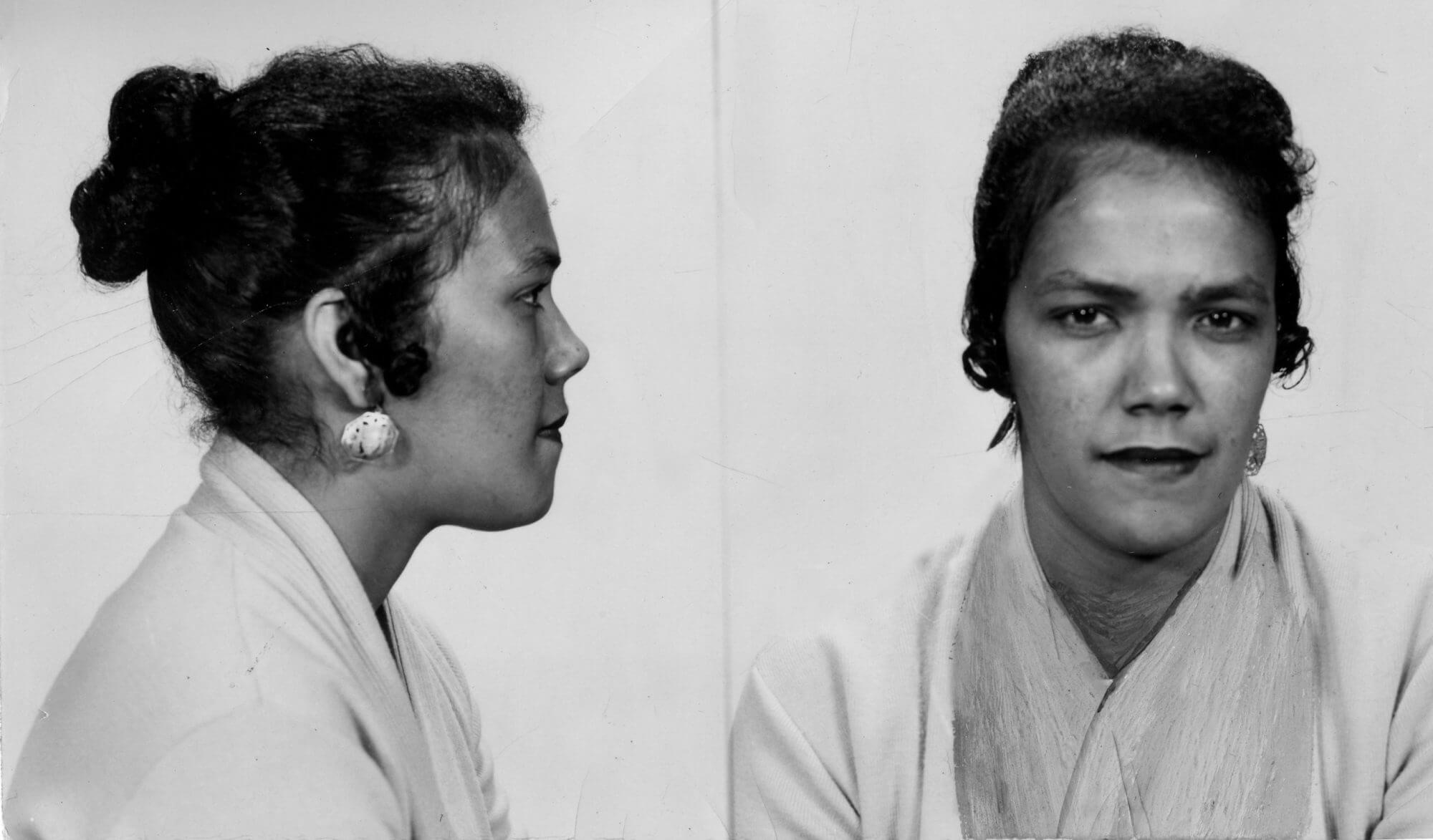
As always, Our Legacy Briefed works to rediscover Black legal history, specifically, how Black citizens’ interactions with state and federal law has led to the provisions and the restrictions all Americans abide by. Such an interaction can be seen in the case of Mapp v. Ohio (1961), giving teeth to the Fourth amendment which serves as a deterrence to illegal search in seizure and police misconduct.
The Fourth Amendment states in one section:
The right of the people to be secure in their persons, houses, papers, and effects, against unreasonable searches and seizures, shall not be violated, and no Warrants shall issue, but upon probable cause, supported by Oath or affirmation, and particularly describing the place to be searched, and the persons or things to be seized.
In May of 1957, a bombing took place at an up and coming boxing promoter’s house: his name recorded as Don King. Three plainclothes police officers approached the home of Dollree Mapp claiming suspicion that the suspect of the recent bombing was hiding out in the home. Mapp, a negro woman around 30 years of age, called her lawyer and was advised to refuse admittance of officers into the home without presentation of a warrant. Mapp did just that and refused officers entry to the home. About 3 to 4 hours later, and with several additional officers arriving on the scene, Mapp was demanded once again to let the officers into her home. Upon refusal, one of her doors was broken into, and officers began to swarm the residence, searching the home, dressers, and other private storage spaces.

Upon entry, Mapp demanded to see a warrant and was presented with a document. Mapp snatched the document and put it in her bosom, however, she was forcibly detained by officers on account of acting “belligerent.” The document was then retrieved from Mapp’s bosom. Mapp’s attorney had arrived on the scene but was refused access to both the residence and to his client, Dollree Mapp.
Upon the forcible search and seizure, officers found lascivious books and photos in Mapp’s home. The lewd evidence was then used to charge Dollree Mapp with possession of obscene materials. Initially, Ohio’s Eighth District Court of Appeals and the Ohio Supreme Court upheld her conviction, however, in 1961, the U.S. Supreme Court heard Mapp’s appeal.
The appeal to the United States Supreme Court would consider the decisions of several similar court cases before it. In upholding stare decisis, or, “to stand by things decided,” the court should follow precedents of previous judicial decisions when making its ruling. The court cases in question were Boyd v. United States (1886), Weeks v. United States (1914), and Wolf v. Colorado (1949).
In reference to Boyd v. United States (1886), a case 75 years prior to Mapp’s, both the Fourth and Fifth amendment worked in tandem. The Fifth amendment stating:
No person shall be held to answer for a capital, or otherwise infamous crime, unless on a presentment or indictment of a Grand Jury, except in cases arising in the land or naval forces, or in the Militia, when in actual service in time of War or public danger; nor shall any person be subject for the same offence to be twice put in jeopardy of life or limb; nor shall be compelled in any criminal case to be a witness against himself, nor be deprived of life, liberty, or property, without due process of law; nor shall private property be taken for public use, without just compensation.
The most significant portion of this amendment, that no person, “shall be compelled in any criminal case to be a witness against himself, nor be deprived of life, liberty, or property, without due process of law,” reinforces individual liberties concerning the right to private property and the right against self-incrimination in the face of government authority. Less than 30 years later in the case of Weeks v. United States (1914), the Supreme Court would reinforce that federal courts and officers would be limited in their power in respect to individual constitutional rights. The case which created the “exclusionary rule” through the Fourth amendment reinforces that “those executing Federal criminal laws to obtain convictions by means of unlawful seizures and enforced confessions in violation of Federal rights are not to be sanctioned by the courts which are charged with the support of constitutional rights.”
Yet in the case of Wolf v. Colorado (1949), Colorado’s state court determined that “in a prosecution in a State court for a State crime, the Fourth Amendment does not forbid the admission of evidence obtained by an unreasonable search and seizure.” However, the Mapp v. Ohio (1961) Supreme Court appeal case would overturn this determination with a 6-3 vote in favor of Mapp.
Mapp’s legal win set a precedent that “the Fourth Amendment’s protections against illegal search and seizure applied to proceedings in state courts as well as proceedings in federal courts, protecting all citizens from police misconduct and the use of evidence obtained from such acts in court. Mapp’s legal battle has earned her the moniker “The Rosa Parks of the Fourth Amendment,” coined by a law professor featured in Essence Magazine.


Leave a Comment